Five Montana Treasures To See At New History Museum
With a 70,000-squarefoot addition to an existing 95,000-square-foot building, the revamped Montana Heritage Center will put a broader slice of the museum’s 60,000item collection on display for public inspection.
“This isn’t just brick and mortar and steel. This embodies the soul of who we are as Montanans — where we’ve come from and where we’re going,” Tim Fox, the Montana Historical Society’s board president and a former state attorney general, said during the Tuesday, Dec. 2, opening ceremony.
Among the highlights of the expanded facility, which is located across the street from the state Capitol, are an extensive array of artifacts from Montana’s history, ranging from Ice Age relics to a nugget purportedly sourced from the Last Chance Gulch gold strike that resulted in Helena’s founding. The building also includes rotating exhibit space, classrooms, a cafe and an extensive gallery dedicated to prolific cowboy artist Charles M. Russell.
Both the history exhibits and the new Russell gallery include items from the museum’s collection that were previously kept in storage by space constraints.
Many treasures caught our eye Tuesday as the historical society invited reporters to roam the exhibits briefly in advance of the public opening. Here are five that stood out: #1 — Pikuni Moccasins
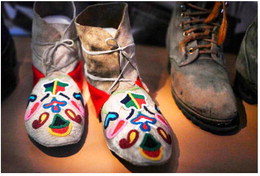
The entrance to the museum’s permanent Montana history exhibit includes an array of shoes intended to represent Montanans from many different eras. Among them are a pair of impeccably preserved Pikuni, or Blackfeet, moccasins donated to what is now the historical society in the 1890s. A few feet away from the moccasins are a pair of combat boots once worn by Candice Griffith, who became the first Montana woman to lead soldiers as an officer in Afghanistan during a 2010 Montana Army National Guard deployment.
#2 — An immmigrant’s Steamer Trunk The labeling on this steamer trunk indicates it accompanied a Helena-bound European immigrant as they journeyed toward what was then the Montana territory, presumably during the era when potential gold rush riches were a major draw into the state.
It’s a favorite of curator Aaron Genton, who said the trunk was actually found at an antique store, leaving the identity of its former owner a mystery.
“We really wanted to do justice to the number and types of people who have called Montana home over the years,” Genton said. “And so, to me, it’s really compelling to think of somebody internationally who packed up their whole lives in a trunk like this and moved here, brought it here.”
# 3 — A Yellowstone Stagecoach This Minerva stagecoach used by early Yellowstone National Park tourists is among the larger objects on display in the main history exhibit — and one that space constraints in the old building previously kept in storage.
“It’s a beautiful coach, but it’s also really interesting to think about how tourists traveled through Yellowstone on coaches like this, on extremely bumpy roads and extremely dusty roads,” said curator Amanda Streeter Trum. “It’s just kind of fun to think about how they experienced the park.”
While the stagecoach’s age means museum staff must take care when moving it, Streeter Trum noted it’s still “technically operational.”
# 4 — Charlie Russell’s Unfinished Sculpture Russell was working on this wax-and-plaster sculpture as a Christmas gift for his wife when he died in October 1926, said curator Jennifer Bottomly-O’looney. Among the incomplete details is a missing arm on the stagecoach driver.
#5 — A COVID-19 Mask
Museum staff said that they’re continuing to collect new artifacts as the present day is transformed into history. Among the newer items on display is a face mask from the COVID-19 pandemic.
“None of us really thought that the face masks we were wearing were going to be museum artifacts one day, but they’re literally historic,” Genton said. “You never know when you’re living through the moment that could become the past.”
The new museum building was funded with a combination of state and private dollars, including $60 million in private donations and more than $40 million in state funds, according to the historical society. The public dollars are primarily money from a percentage-point increase to the state’s lodging tax approved by lawmakers in 2019 after years of failed efforts to push funding for the museum through the state Legislature.
The museum project was supported by philanthropic gifts from more than 1,300 donors, including a $25 million gift from the Dennis and Phyllis Washington Foundation, a $10.4 million gift from Norm Asbjornson and a $5 million gift from BNSF Railway. Dennis Washington, an industrialist who is Montana’s wealthiest person, and Asbjornson, who built a major heating and ventilation company after growing up in rural Montana, both spoke at Tuesday’s opening ceremony, as did Gov. Greg Gianforte.
The museum has free admission and is open to the public seven days a week.


