hummed in Libby — employing ….
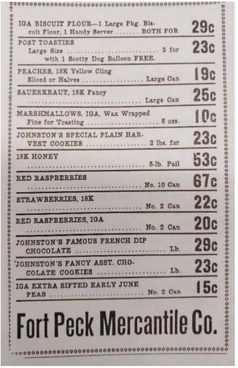
hummed in Libby — employing an abundance of workers. Mining was still in play, as the Zonolite Company pulled vermiculite from the earth. Smaller operations extracted gold, lead, and silver. As with many communities, the Great Northern Railway remained an economic hub — shipping lumber and minerals and employing a substantial number of people.
• Libby’s durable miners and loggers sprouted large families of resilient children — and the toughest of the lot made up their mighty football team.
• Before the title game, The Helena Daily Independent headlined: “Poplar’s Crack Team Composed of Rookies.” They were referring to the Indian roster that was rocked by graduation from the past two years.
• The paper continued with hyperbolic comparisons to war that was typical of the sportswriting of the day — identifying the players that “will carry the Poplar colors in the battle with Libby.” Per the
Daily Independent: “Captain Maruice Archdale, Claude Trinder and Jimmy Westfall, halfbacks; Robert “Dib” Edeline, fullback; Grant Trenne, quarterback; Fred Summers, Duncan Dupree and Jimmy O’Connor, ends; Vincent Pilgram, Gilbert Mason and Robert Grainger, tackles; Earl Marquardt, Robert Voorhees and Edward Manning, guards; Eddie Bauer and Willie Youpee, centers.” The Indians averaged 157 pounds as a team and were coached by Carl O. Hansen, an allsport star from North Dakota State College (now NDSU).
• The Wolf Point Herald wrote, “Expert opinion favors Poplar to win, and the Roosevelt County fans are pulling for them.”
• But it would be the purple and white of the Libby Terriers that would prevail, as they, “tore the Poplar line to shreds,” reported Libby’s Western News. “With a smashing and bruising attack that would have downed most Class A teams, Coach Vogt’s Terriers over-powered a fighting Poplar team ... 18-0.” The paper praised Poplar’s freshman fullback, Dib Edeline, as well as quarterback, Grant Trenne. Two linemen were acknowledged: Eddie Bauer and Robert Voorhees. The Billings Gazette praised Poplar for executing their plays, “snappily.”
“The Poplar Boys were Splendid Losers”
• E.A. Hinderman, superintendent from Whitefi sh was the referee. Poplar agreed to have him select the other two officials. Poplar was guaranteed $325 to play Libby.
• Upon winning the game, the Libby players selected who they felt were the best players they faced all year. Poplar’s were: Mason, Dupree, and Westfall; honorable mention went to Summers, Trinder and Edeline. Other players came from Cut Bank, Eureka, Corvallis, and Plains.
• Poplar schools received congratulations from several schools and other institutions including an acknowledgment from the McCone County Sentinel located in Circle.
• Both team’s losses came from Class A schools — Libby to Kalispell and Whitefish. Poplar lost to Glasgow.
• The Kalispell Times announced: “Libby had much the better of the argument with Poplar ... and was superior in every department.”
• It was a joyful festival in Libby, which lasted for days. At one banquet hosted by the Lions Club, Libby’s superintendent warned the team that next year’s opponents would give the Terriers their “hardest licks” in trying to win.
• From the Western News, “The Libby team proved to be gracious winners and the Poplar boys were splendid losers.”
• This game was during the Great Depression. For Poplar, the dry years had begun about 15 years earlier, as farmers were drained from battling economic challenges — including bank closings. Grasshoppers ravaged what little grain survived in 1931 and 1932. People went hungry.
• During The Great Depression, citizens pulled together — including rival football towns. The Libby community were gracious hosts, putting the Poplar team up in their gymnasium that included cots provided by the U.S. Forest Service. Saturday and Sunday mornings they were “treated to delicious hunter’s breakfast.” They also invited the Indians into their homes and serving them meals — the most common being “venison dinners with huckleberry trimmings.”
• Of course, with huckleberries being a unique treat to the western mountains, this variety of fruit was much different than the Juneberries, chokecherries, buffaloberries, currants, gooseberries, wild plums and rose hips that the Poplar community traditionally harvested and prepared in a variety of ways.
• One of the last entries of the monstrous odyssey was recorded by Havre’s
Hill County News: “The Poplar football team returned Sunday night from Libby, passing through Havre on No. 2 ...”
• In 1953, the Libby Terriers became the Libby Loggers, and today they are royal blue and gold — instead of purple and white.
• Like many of his Poplar teammates and peers, Duncan Dupree served in WWII. And like many of his fellow Poplar-ites, Captain Duncan Dupree — the winner of The Silver Star — paid the ultimate price: he was killed in Papua New Guinea in 1943.