New Era For Dry-Redwater Regional Water Authority
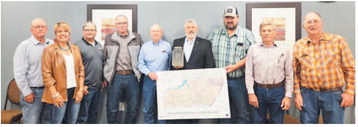
Dry-Redwater Regional Water Authority board chairman Mike Trotter recently provided an update on DRWA’s activities. Trotter summarized that in December 2025, the Bureau of Reclamation issued its final concluding report for the Dry-Redwater Rural Water Project Feasibility Study. The concluding report emphasized the need for DRWA’s Rural Water Project, confirmed the Bureau of Reclamation’s support of the project and paved the way for DRWA to seek federal authorization for the project.
On May 12, U.S. Sen. Steve Daines introduced S. 4489, the Dry-Redwater Regional Water Authorization Act during the 2026 session of the 119th Congress. Co-sponsored by U.S. Tim Sheehy, the Senate Bill, upon passage, will provide DRWA the necessary approval to carry out the project. The Senate Bill was referred to the Senate Committee on Energy and Natural Resources. Also on May 12, U.S. Rep. Troy Downing introduced H.R. 8745, an identical bill to the Senate Bill. H.R. 8745 was referred to the House Committee on Natural Resources. Trotter said, “The project is entering a new era, and will become a reality upon congressional approval.” He noted hearings in the respective Senate and House Committees are expected to be held this fall, and anticipates full votes on the Senate Bill and House Bill before Congress adjourns at year-end. Trotter expressed sincere appreciation to Daines for his unwavering support of the project during all of Daines’ years of service in the Senate.
“Sen. Daines is a champion of this project and has insisted that it meet the highest standards of feasibility.” Trotter also expressed appreciation to the newer members of the Montana legislative delegation who have taken up support of the project. Trotter explained he would provide testimony at upcoming hearings and urged towns and individuals in the project area to also submit written testimony. “There is great local support for the project,” Trotter said, “and a few that oppose it. We welcome all points of view.”
Trotter also reviewed the nature of the project. He explained, “The project will serve ranchers, farmers, businesses, non-profits, for-profits, townspeople, rural people and essential service providers such as schools and clinics with high-quality water from the Missouri River treated to the highest standards. The DRWA water rights to the Missouri River are filed and on record with the state of Montana. Towns will receive water from DRWA through municipal supply agreements, and individuals will receive water through enrollment in the project and two grants of easements for the construction, operation, and maintenance of the project’s facilities. The project is expected to serve about 1,500 rural households and, at least, the towns of Jordan, Circle, Richey, Lambert, Savage, Glendive and Fallon. Additionally, the project is expected to install many pasture taps across our service area in support of our livestock industry. Connection to DRWA is strictly voluntary, and those who choose not to enroll will continue to use the water source they currently rely upon. Trotter also noted, “We encourage towns and rural users that connect to DRWA to also retain their existing water sources and water rights. Folks should feel secure that connecting to DRWA does not mean they are abandoning their water rights or their wells, in case they want to continue to use them. Existing wells, for example, can be used any time the owner wants. We will protect DRWA water from cross-contamination with existing wells and other water sources, but everyone will be able to keep their existing water source even after they connect to DRWA. Importantly, DRWA will not be using any groundwater, except temporarily for interim projects, once our renewable Missouri River water source is available.” Several of DRWA’s board members also provided statements in support of the project. Board member Tom Ruffatto brought attention to the support the Richland County commissioners provided DRWA in utilizing the City of Sidney’s existing water resources and Richland County’s available funding to improve water access to local residents and businesses. Ruffatto states, “Richland County has been a major proponent of the project and helped us work with the City of Sidney as early as 2012 to contract for the Town’s unused water supply to serve that area southwest of town – generally around the Mount Pleasant Estates and the Valley View Water Users Association areas. We developed an interim water system in that area to serve over 50 homes, utilizing grants received from Richland County that helped fund construction.” Ruffatto further said DRWA continues to provide water and sewer service there to-date, and recognized the importance of funding assistance received from Montana Department of Natural Resources and Conservation in the development of that interim project. “It’s interim projects like this that bring better quality and more reliable water to people in the early stages of our project’s development, and this interim project was only possible due to the forward thinking of the Richland County commissioners and their prioritization of valuable resources and funding.” Ruffatto also remarked that additional interim projects to serve new areas around the City of Sidney are being considered. “Additional interim projects are being designed to bring better water to even more people as soon as we can, and efforts are being taken to ensure these interim projects fit easily and inexpensively into the project when our Missouri River water source is available,” he said. Board Member Boone Whitmer added that other rural water projects, similar to DRWA’s Project, but located north of the Missouri River, are very successful and supply high-quality water without shortage or noticeable interruption of service. “Many towns and 90 percent of the rural users are served by the Assiniboine and Sioux and Dry Prairie rural water projects. While some chose not to connect to those projects initially, most joined those projects once they saw the projects developing. Some also requested connection for an occupied home and one or more unoccupied homes that were part of a farm or ranch operation. The net result was a lot of participation. Many were uncertain of those projects in the beginning, and they decided they wanted to connect to those projects as they saw progress, and I believe DRWA will have the same experience.” Board member Jim Moos said, “We have many steps ahead to make this project function in a way similar to the Assiniboine and Sioux and Dry Prairie projects. Our goal is the same as theirs, namely bringing high-quality water, at reasonable costs, to as many as choose to enroll voluntarily.” Regarding project funding, Moos states, “The United States government will provide 75 percent of the construction costs, and the State of Montana and DRWA will share equally in providing the remaining 25 percent. We will work with the Montana legislature to secure state authority for regional water funds through grants and loans.” DRWA’s executive director Jeannie Rosseland summarized the importance of receiving federal authorization and explained in layman terms what the passage of the Senate Bill and the House of Representatives Bill will do for the project. Rosseland said, “The passage of Senate Bill 4489 and House of Representatives Bill 8745 will simply provide DRWA the legal ability to move the project forward under the Project scope and the Project budget defined within the feasibility study, the concluding report, and all other associated documents.”
Specifically, Rosseland states the funding will aid in the design and construction of the projects many components, including its surface water intake, its state-of-the-art water treatment plant, its substantial distribution network, its power supply and its booster stations, to name a few. Rosseland added, “The lack of access to high-quality water, throughout our five-county service area, is long-standing, well documented, and personally experienced while I was growing up on a farm and ranch west of Circle. The project provides a solution to this problem, and I’m honored to be part of the tremendous team of legislators, individuals, businesses and state and federal agencies working together with the goal of obtaining the project’s federal authorization by the end of the year.” Rosseland further describes DRWA’s new office headquarters in Circle and her enthusiasm for what economic benefits the project will generate once authorized and throughout the construction and project completion phases, and beyond. She said, “We have recently moved our office to 111 Main St. in Circle, and have made substantial investments in that property to serve our current needs and expected future needs. We have also recently invested in software upgrades and staff training for our accounting system, and in improved state-of-the-art meter reading equipment for our customers. It is likely we will grow from our current staff of two to a staff of five or more, as we handle more and more of the project’s necessary duties in-house. This includes things such as easement acquisitions and connection agreements, construction, administration and inspection, financial management, and auditing. Then, once our project is completed, we will support even more permanent, well-paying jobs for the operation and maintenance of the system.” Rosseland also states that based on engineering estimates, the contractors that build the project will employ more than 400 full-time equivalent workers over a span of 25 years, which is the same as approximately 16 full-time employees annually. Indirect and supporting employment will add another five to 10 jobs annually.
“Such an economic benefi t cannot be discounted,” Rosseland concludes. Trotter also introduced DRWA’s new engineering team of DGR Engineering, Watson Engineering, and Burns & McDonnell, and discussed the importance of partnering with them pursuant to their successful completion of major rural water projects across the Great Plains and their ability to have shove- ready projects available as federal authorization is enacted and funding becomes available. Trotter added the construction of the project will be governed by a programmatic agreement to meet all environmental requirements related to the Clean Water Act, the Endangered Species Act, the National Historic Preservation Act, and NEPA and MEPA compliance. Trotter concluded by saying, “We are committed to the people of this region. We will bring safe and reliable water while complying with all state and federal regulations and while managing large funds responsibly and in accordance with accepted standards for federal and state financial systems. Property values will increase, business will be attracted, livestock will gain weight, and people in the region will be healthier. We look forward to working cooperatively with everyone.”


