Tribes Tell Stories Themselves In New State Museum
Some museums resist incorporating smudging, a traditional Indigenous cleansing practice, out of fear that the smoke could damage exhibits or bother visitors. It involves participants burning sage, sweetgrass or tobacco in a shell and then blowing out the flames and wafting the smoke over themselves.
But the smudging room stands prominently at the east entrance of the new Montana Heritage Center, located there because Plains tribes traditionally built their tipi doorways facing east to greet the rising sun.
“This kind of stuff is usually a little bit of a fight for a lot of museums,” Nina Sanders, the state history museum’s first curator of Indigenous collections, said on a recent December afternoon as she gazed up at the high ceilings, sunlight beaming in from above.
“Everybody was incredibly open,” she continued. The room has an HVAC system to filter smoke, there’s plenty of natural light and spaces to sit.
The inclusion of, and intentionality behind, the smudge room is just one example of how museum leaders partnered with tribes to ensure Native American stories are accurately reflected in the new exhibits.
“[Smudging is] important to us because we view these artifacts as living items,” said Major Robinson, a citizen of the Northern Cheyenne Tribe who worked as a consultant for the heritage center’s remodel. “And so when you’re interacting with them, you want to protect yourself and take care of yourself. That’s why we encourage people to go in there, smudge yourself and go in and see these exhibit spaces.”
Sanders, who is Apsáalooke and has worked for the Smithsonian’s National Museum of the American Indian and Field Museum in Chicago, said it’s not uncommon for museums to have just one section dedicated to Native Americans.
“That doesn’t happen here,” she added. “We do have a section that’s allocated to Native people, but you’re going to see their history shown throughout. It’s woven through, as it should be, because it’s all of our history.”
History, as told by museums, can also favor written perspectives from researchers and anthropologists, which can lead to a White-focused experience, rather than one that acknowledges Native culture that predated settler arrival by millenia. The new state history museum, however, aims to share multiple perspectives to, as Sanders says, “tell the truth of history.”
A Walk Through The Museum Adjacent to the smudge room, the first exhibit at the museum’s east entrance is a display of shoes — including moccasins, cowboy boots, military boots, sneakers, sandals and high heels — in a circle, representing a round dance, a traditional Indigenous ceremony in which participants form a circle.
“It’s very celebratory,” said Amanda Trum, curator of collections at the heritage center. “It’s very uplifting. And you feel like you’re represented in some way, whether you’re a cowboy, a skier, or a Native person.”
Another exhibit shows a flattened Cree tipi from the 1800s that weighs just 30 pounds. There’s also an elk tooth dress that belonged to a survivor of the 1870 Baker Massacre, in which U.S. troops killed at least 173 people at a peaceful Blackfeet camp. A book of drawings by George Catlin, a 19th-century painter and traveler, shows some of the earliest depictions of Native Americans.
Another area of the museum tells the story of genocide, starvation and assimilation. Exhibits detail the 1851 Fort Laramie Treaty, 1855 Lame Bull Treaty and 1855 Hell Gate Treaty — agreements that tribes, often under duress, reached with the federal government that have far-reaching consequences today. A nearby exhibit on the boarding school era features an Apsáalooke child’s drawing of officers taking a child from her mother. A large backlit photo of a flyer reads “Indian land for sale” in big, block letters.
Sanders said the exhibit engages visitors in “a serious conversation about the death and destruction and the taking of the land.” She knows it can make people feel uncomfortable, which she says, “is OK.”
“We should have moments where we’re a little bit uncomfortable and start thinking about our past and how we would rather do things in the future,” she said.
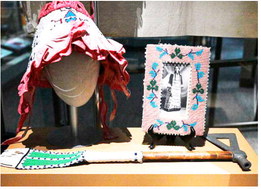
Adjacent to that exhibit, though, is one of Native resilience, featuring Indigenous art — beaded moccasins, picture frames and belts, among other items.
“Even when things were terrible, they were still creating beautiful things,” Sanders said. “And it’s not art for art’s sake. They’re creating incredible things for their family members, for people that they love.”
The sovereign nations section of the museum is Robinson’s favorite exhibit. Each tribal nation has a dedicated display case, and each nation’s leaders chose the items inside. The Chippewa Cree Tribe’s case features state Sen. Jonathan Windy Boy’s grass dancing outfit. The Apsáalooke case displays a beaded vest.
From there, museum visitors can step into a lodge, or tipi, where videos showcase each tribe’s celebrations, songs, languages and cultural leaders.
“If you see the film there and watch it the whole way through, it shows all of the sovereign homelands of Montana,” Robinson said. “It really captures the beauty of our land, our people, our traditions. I love how you can just sit and drink that in.”
Robinson hopes that when visiting the museum, Native Americans see themselves, their relatives and their communities authentically reflected. He hopes non-Native visitors come away with a greater understanding of — and appreciation for — the nation’s first people.
“Our contributions are important,” he said.
Tribal collaboration
Tribal relationships with museums can be complicated. Where museums might describe items as artifacts, Sanders said, tribal community members may see them as living objects, ancestors or relatives. And while items in museums are often displayed behind glass cases, not to be touched, it may be important for some tribal members to interact with items for cultural and religious reasons.
Most of the Native items on display or in the museum’s collection were donated from individuals or institutions, she said.
Some items may have been obtained hundreds of years ago by fur traders. In some instances, wealthy families traded services, like health care, for Native items. Federal agents would also withhold food rations in exchange for objects. And anthropologists collected items.
Tribes may also not want museums to display certain items, like burial objects, human remains and religious items. One exhibit in the state’s history museum includes a video about an Indigenous child whose remains were found in 1968 in southwest Montana. The child’s remains are estimated to be at least 12,000 years old, and he was buried with dozens of tools. The child’s remains were later reburied at the site in 2014. Rather than display the tools or replicas of them, the heritage center’s exhibit features photos of the tools and a video where contemporary Native leaders share why they believe the tools should be reinterred.
History, as told by museums, can also favor written perspectives from researchers and anthropologists, rather than oral histories and traditions from tribes. A researcher may know one incident as a battle, for example, where a tribe knows it as a massacre.
Because museums help inform academics, historians, educators and the general public, Sanders said, tribal collaboration is critical.
“When Native people engage with museums, they’re giving themselves and their communities the opportunity or a space to tell the stories themselves,” she said.
But establishing meaningful and lasting relationships with Native leaders across the state isn’t easy. It takes time, effort and a long-term commitment to building trust.
Each tribe in Montana has a historic preservation officer, responsible for managing cultural programs and ensuring the protection of sacred sites, traditions and items. Historic preservation officers, Sanders said, wear lots of hats in their communities, often operating with a small staff and limited funding. Displaying tribal items in a state museum, she said, may not be among their top priorities. Plus, the heritage center is run by the state, which Robinson said can trigger “a healthy skepticism” among tribal leaders.
“You know, when the state comes in and says, ‘We’re here to help,’ tribal members are going to take 10 steps back and think, ‘OK, how’s this going to work?” he said.
To meaningfully collaborate with tribes during the museum-planning process, representatives from the Montana Heritage Center met with tribal governments across Montana and asked each council to recommend people from their own communities to join a stakeholder group. That group, composed of about 15 tribal cultural leaders and historic preservation officers, met regularly with museum leaders to provide feedback on exhibits, objects and narrative framing. Robinson, a member of the stakeholder group, said the collaboration strengthened the entire exhibition.
“By doing that authentically with them, I feel the stories went deeper,” he said. “This is a deep collection and a deep representation of Native people.”


