In Miles City, What Makes A Bucking Horse Stand Out?
Every May, the eastern Montana town of Miles City goes from a population of 8,000 people to over 20,000, all there to attend the Miles City Bucking Horse Sale, a weekend that has become equal parts rodeo, reunion and proving ground for some of the country’s top bucking stock.
What began in 1951 as a local horse sale has grown into one of the largest events of its kind in the West, drawing stock contractors, ranchers and riders from across the country. Alongside parades, concerts and rodeo performances, the sale itself remains the centerpiece. Young bucking horses are showcased, sold and evaluated for future rodeo careers.
So, what actually makes a horse that bucks into a high-quality bucking horse with rodeo potential? And what makes for a winning rider? I attended the Orin Muri Permit Challenge, which gives newer riders a chance to compete their way into the professional ranks, to find out.
Semi-Untrainable Desire To Buck Riders and experts at the sale this year said that turning a horse into a bucking horse worthy of Miles City comes down to a handful of factors: breeding, athleticism, instinct and an almost impossible-to-train desire to buck. “More than anything, it’s just the free spirit of the horse,” said bronc rider Milo Paz.
Paz, 29, grew up around bucking horses on the Crow Reservation through his family’s operation, Real Bird Bucking Horses. Long before he competed himself, he spent his childhood feeding horses, moving them between pastures and watching older generations work stock.
“It’s just the wildness of that horse, the spirit that remains,” Paz said about a horse’s bucking instinct. “It doesn’t matter what’s going on. Yesterday, today, if it’s raining, he still knows he gets in there, and he has a job to do.”
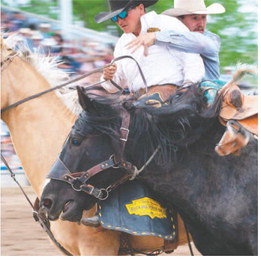
Modern rodeo bucking horses typically compete in two events: saddle bronc riding and bareback riding. Saddle bronc riders use a specialized saddle and rein while bareback riders hold onto a rigging with one hand as the horse launches beneath them. At the Miles City sale, many of the featured horses are futurity horses — younger animals being evaluated for breeding potential, consistency and athletic ability before entering larger rodeo circuits. The three-year-olds demonstrate with a dummy. The older ones buck with a rider.
The horse’s performance is scored separately from the rider’s, with both components adding up toward an overall score. Judges look for power, timing, kick and movement. Riders say the best horses quickly earn reputations of their own.
“Breeding, size, strength, how high he can kick over his head,” Paz said of other bucking horse characteristics.
Paz and other longtime bronc riders describe the flank strap, which is placed around a horse’s hindquarters during competition, as a cue that nudges the horse to react, but not a painful device.
“Lightly snug enough where he thinks he can kick it off,” Paz said. “That’s what gets him to kick it in the air.”
Josh Davison, a Miles City bronc rider, added that many horses continue bucking even after the strap comes loose.
“They still go out and buck, jump, kick. They love it,” he said.
In rodeo and bucking horse breeding, horses are also scored for their appearance in competition or one trip out of the chute. The number of times a horse competes demonstrates its consistency and longevity over time.
Experts and hobbyists in this world refer to people who own, breed and train horses as contractors. Many contractors now track bloodlines the same way ranchers track cattle genetics or racehorse breeders study pedigrees. Certain mares and studs consistently produce athletic horses capable of competing at the highest levels of rodeo.
“Most times, horses are bred to buck,” said Davison, who has spent nearly 18 years in the sport. For riders, Davison continued, “it’s only fun when they buck. They need to be a good dancing partner.”
Winning Mindset For Riders Davison started in youth rodeo before working his way into bronc riding and helping coach younger riders through rodeo camps. One of the biggest lessons he teaches has little to do with physical strength.
“The mental game is definitely the hardest,” he said. “You can’t let the bad rides and the low parts of rodeo get to you because that’s going to affect your next ride.”
There are plenty of riders who can hold onto an unruly bronc, Davison said. What sets competitors apart is confi dence.
“If you can’t go in with the mindset that you can win that rodeo, don’t go,” he said.
That mindset becomes especially important in the seconds before the chute opens. Behind the bucking chutes, riders narrow their focus to a handful of thoughts while trying to keep adrenaline under control.
Paz said he reminds himself to stay calm before climbing aboard.
“You already know that horse is a little nervous,” he said. “Some of them freak out in there. Some of them look calm, but deep down they’re just as nervous as you are.”
His mental checklist also comes down to thinking about simple choreography: “Stick to the basics. Lift on your rein. Throw your feet forward. Stay in your swells.”
The swells refer to the raised, widest area at the front of a Western saddle, positioned right behind the saddle horn. When a horse drops its head and kicks, the movement throws a rider’s weight forward. Riders use their legs to stay centered in the saddle, locking their knees and thighs against the swells while leaning back to stay balanced with the horse’s movement.
Davison approaches those moments similarly, reducing the ride to a few confident mantras. Before he gets on, he tells himself: “I’m a champion. There is no horse here that can buck me off.”
Once he climbs into the chute, Davison simplifies everything down to three things — the same advice he gives students he coaches at rodeo camps.
“Relax, stay back, set your feet,” Davison said. “I tell kids, think of only three things. Little mental footnotes that subconsciously you want to do during a ride.”
That confidence is built through repetition long before rodeo season starts. Riders spend hours practicing on spur boards, riding horses at home and training their bodies to react instinctively to a horse’s movement.
“You can feel it if you skip a couple of days,” Paz said. “It’s all quick reaction, quick timing.”
The physical demands of the job are brutal. Paz recently returned to competition after suffering a broken ankle, collapsed lung, broken ribs and wrist injuries over a three-year stretch.
Ultimately, success in the arena comes down to riders working closely with their horses. Both contribute to the final score out of 100 points, with half based on the rider’s control and rhythm and half on the horse’s bucking effort. Top finishers usually earn cash prizes. At this year’s 75th Annual Miles City Bucking Horse Sale, the championship payout was $75,000.
For a rider, success comes down to just a handful of seconds. In Miles City, the larger pursuit continues long after the dust settles: finding horses with the instinct to become great bucking stock — and athletes willing to hang on.