Gianforte Highlights Innovations In Agriculture
By Logan Kruse, Montana Department of Agriculture The Felton Angus Ranch Adopts Virtual Fencing Governor Greg Gianforte and Director Streit visited the Felton Angus Ranch in Deer Lodge on Montana Agriculture Day to highlight how Montana producers are using innovative technology to strengthen their operations.
“Our farmers and ranchers are embracing new and emerging technologies to improve their operations and ensure the health of our landscapes and their world-class product,” Gianforte said. “On National Agriculture Day, we celebrate Montana ranchers like the Feltons, who are caring for the land and keeping Montana agriculture strong for the next generation.”
Since 1952, Felton Angus Ranch has operated as a multi-generational family ranch raising registered Angus cattle. In recent years, the ranch has adopted a new technology called Vence for virtual livestock fencing. Vence uses GPS-enabled collars and strategically placed towers to guide cattle movement to keep cattle within set boundaries, allowing ranchers to manage grazing patterns without the need for traditional fencing.
The governor’s visit included a demonstration of the virtual fencing system, showing how ranchers can manage cattle movement and adapt to changing conditions on the ground in real time.
“Like a lot of ranchers, we’re always looking for ways to do things better,” said Jim Felton, owner of Felton Angus Ranch. “This technology helps us manage our cattle more efficiently, take better care of the land, and adapt to challenges we face out here. It’s been a game changer for our operation.”
One of the virtual fencing towers used by the ranch is located on U.S. Forest Service land. During the visit, the governor heard about the importance of landowner relationships with federal partners.
“Tools like virtual fencing give us more flexibility in managing grazing on public lands while supporting the health of the landscape,” said U.S. Forest Service Rangeland Management specialist Alicia Snow. “Working alongside producers, we can better balance resource stewardship with the needs of working lands.”
The Felton Angus Ranch partnered with Merck Animal Health to deploy the virtual fencing technology. Vence allows ranchers to track cattle movement, dictate grazing behavior, and establish an easy-to-manage rotational grazing strategy while helping with predator mitigation and tracking loss of livestock. In Montana, 28 ranches utilize Vence.
“Producers are looking for practical solutions that improve efficiency without adding complexity,” said Allison Burenheide of Merck Animal Health. “Virtual fencing technology helps ranchers make real-time decisions that benefit their operation, their animals, and the land.”
Since taking office, Gov. Gianforte has worked to increase support for Montana’s agriculture industry through tax relief, workforce development, and infrastructure investments that benefit farmers and ranchers.
To support Montana farmers and ranchers, the governor increased the business equipment tax exemption from $100,000 to $1 million, eliminating the business equipment tax burden for more than 5,000 small businesses, farms, and ranches.
Dahlman Farms Affirms the Importance of Global Markets Gianforte also visited Dahlman Farms of Power, to celebrate Montana Agriculture Week and highlight the importance of international trade to Montana farmers and ranchers.
“Montana farmers and ranchers produce some of the highest quality wheat, barley, and beef in the world,” Gianforte said. “Montana farm families like the Dahlmans not only grow crops here at home, but also help tell Montana agriculture’s story abroad, strengthening relationships with trading partners and opening new markets for our producers.”
The Dahlman family has a long history in Montana agriculture. After emigrating from Germany in the late 1800s, the family settled in the Power area as early homesteaders in 1910. In 1958, Lee Dahlman’s parents started the farm, which he continues to operate with his daughter Breanna, son Brody, and their families. Today, the family raises winter wheat, spring wheat, durum, malt barley, lentils, peas, and commercial beef cattle, including registered Red Angus.
In addition to running the farm, Lee holds leadership roles in advancing Montana agriculture. He serves as vice chair of the Montana Wheat and Barley Committee, is active in U.S. Wheat Associates, and the U.S. Grains and BioProducts Council.
Last fall, Dahlman joined Gianforte and other agricultural leaders on a trade mission to South Korea and Japan, focused on expanding export opportunities for Montana products. In Japan,
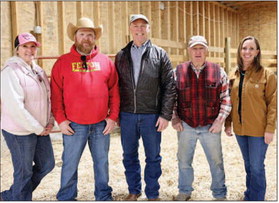
Gov. Gianforte and director Streit with the Felton Family in Deer Lodge.
Photo courtesy of Montana Department of Agriculture the group met with flour milling companies and baking industry representatives who rely on high-quality wheat from Montana and the Northern Plains. And in South Korea, the delegation met with importers and food companies that use Montana wheat in noodles, baked goods, and other products, as well as organizations that promote U.S. grains in international markets.
“These trade missions give farmers like me the opportunity to meet directly with the customers who buy Montana wheat,” Dahlman said. “Seeing how our grain is used overseas and building those relationships helps ensure strong markets for Montana producers for years to come.”
In addition to joining the governor’s trade mission, Dahlman has hosted multiple trade delegations from Asia at his farm and most recently returned from a North Asia board visit to South Korea and Taiwan.
Korea and Japan are consistently in Montana’s top five trading partners. In 2024, Korea was the second largest trading partner, purchasing over $335 million in industrial machinery, coal, beef, and wheat, while Japan was the fourth largest, purchasing over $265 million in exports including agricultural products, wheat, and coal.
“Trade missions help connect Montana farmers and ranchers with customers across the globe,” Gov. Gianforte said. “When we expand markets for Montana agriculture, we support jobs, strengthen rural communities, and keep our number one industry growing.”
Gulch Distillers Embody
Value-Added Agriculture Governor Greg Gianforte also visited Gulch Distillers in Helena to highlight the role of value-added agriculture in growing the state’s number one industry as part of Montana Agriculture Week and Month.
“Montana agriculture is our number one industry, supporting jobs, communities, and our way of life,” Gov. Gianforte said. “Businesses like Gulch Distillers highlight the strength of value-added agriculture by turning Montana-grown grain into award winning products. It was great to visit this business and hear how the Growth Through Agriculture program is helping them expand and thrive.”
Founded in 2015 by Tyrrell Hibbard and Steffen Rasile, Gulch Distillers produces nine grain-based spirits using Montana-grown ingredients. The distillery has earned several national awards and continues to grow Montana’s craft distilling industry while creating new opportunities for value- added agriculture. “We’re proud to craft our spirits using Montana- grown grains and to do it right here in Helena,” said Tyrrell Hibbard, co-owner of Gulch Distillers. “From day one, our goal has been to create high quality products while supporting Montana agriculture and sharing that story with everyone who walks through our doors.”
Last year, Gulch Distillers received a $25,000 grant through the Montana Department of Agriculture’s Growth Through Agriculture program to support factory expansion and the relocation of its tasting room to the former Devore’s Saddlery building on West Lawrence Street to reach more customers.
The visit came ahead of an announcement of 2026 Growth Through Agriculture grant awardees later this year. The program provides grants and loans to strengthen and diversify Montana’s agricultural industry through the development of new agricultural products and processes.
“The Growth Through Agriculture program helps Montana businesses take our world class agricultural products and create new opportunities for producers, entrepreneurs, and rural communities,” Dir. Streit said. “By supporting value-added agriculture, we are helping keep more of Montana’s agricultural value here at home.”
From Opheim to Stevensville, the State of Montana awarded funds to 25 agricultural businesses in 2025 to help expand operations, develop new products, and strengthen Montana’s agricultural economy.
“As we celebrate Montana Agriculture Week, we recognize the farmers, ranchers, and entrepreneurs who add value to Montana-grown products and keep our agricultural economy strong,” Gianforte said.
Gov. Greg Gianforte speaking with Lee Dahlman of Dahlman Farms. Photo courtesy of Montana Department of Agriculture
Gianforte speaks with Tyrrell Hibbard of Gulch Distillers.
Photo courtesy of Montana Department of Agriculture