September Runoff Below Average For Missouri River
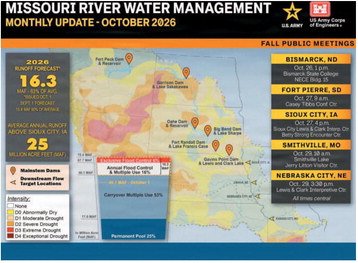
September runoff in the upper Missouri River Basin was below average, continuing the trend of below-average runoff in 2026.
“Although precipitation was wetter-than-normal in September for large areas of the lower basin, portions of the upper basin were dry and warm, causing the September runoff in in the upper basin to be below average,” said John Remus, chief of the U.S. Army Corps of Engineers’ Missouri River Basin Water Management Division.
“Runoff into the Fort Randall and Gavins Point reaches of the Missouri River, however, were well above normal. Precipitation downstream of Gavins Point Dam increased tributary flows and allowed Gavins Point releases to be reduced, while maintaining navigation flow support downstream,” Remus added.
September runoff was 1.0 million acre-feet (MAF), 82 percent of average for the basin above Sioux City, 0.5 MAF more than forecast. September precipitation was 200 to 400 percent of normal over large areas of the basin except in Wyoming and northern Colorado. According to the Sept. 30 drought monitor, approximately 72 percent of the Basin is still experiencing abnormally dry or drought conditions. Drought conditions are expected to persist or expand in Montana, northwestern Wyoming, western North Dakota, and western South Dakota through December, but improve over the rest of the basin.
The 2026 calendar year runoff forecast for the Missouri River Basin above Sioux City, Iowa is 16.3 MAF, 63 percent of average and 0.9 MAF more than last month’s forecast. If realized, this forecast would be the 14th lowest runoff in the period of record.
As of Oct. 1, the total volume of water stored in the System was 46.1 MAF, which is 10 MAF below the base of the System’s flood control zone. System storage is forecasted to continue declining through the fall. The updated reservoir studies indicate that the System storage is expected to be 44.7 MAF at the start of the 2027 runoff season, approximately 11.4 MAF below the base of flood control.
Fall Release Rate
Gavins Point releases can be reduced to water supply release rates during extended droughts when the navigation flow support season ends earlier than December 1 per the Master Manual. Gavins Point releases may be reduced to the water supply release of 9,000 cfs for approximately two weeks prior to the winter release rate beginning on Dec. 1. Downstream tributary flows will be monitored during this period and releases will be adjusted as necessary if there is not sufficient flow downstream of Gavins Point.
Winter Release Rate
As per the criteria in the Master Manual, the winter release rate is determined from the Sept. 1 System storage. Per the September 1 System storage, winter releases from Gavins Point Dam will be at least 12,000 cubic feet per second. In anticipation of the low winter releases, a letter was sent to water users below Gavins Point Dam making them aware of the planned releases and encouraging them to assess the risk to their facilities.
Draft Annual Operating Plan In September, the USACE posted the draft 2026-2027 Annual Operating Plan on its website at: https://go. mil/mr- meetings. The comment period on the draft AOP will close on Nov. 27.
Garrison Dam
Average releases past month – 14,900 cfs Current release rate – 13,000 cfs Forecast average release rate – 13,000 cfs End-of-September reservoir level – 1824.3 feet (down 0.9 feet since August 31) Forecast end-of-October reservoir level – 1824.0 feet Fort Peck Dam
Average releases past month – 6,900 cfs Current release rate – 7,000 cfs Forecast average release rate – 7,000 cfs End-of-September reservoir level – 2222.2 feet (down 0.8 feet since August 31) Forecast end-of-October reservoir level – 2221.2 feet The forecast reservoir releases and elevations discussed above are not definitive. Additional precipitation, lack of precipitation or other circumstances could cause adjustments to the reservoir release rates.