Coalition Says No Farm Bill Without Mandatory Beef Labeling
There’s probably nothing more iconic to Montana than boots, cowboy hats, cattle and ranching, something that defines the image of the Treasure State. And there is probably no other blocs of voters that Montana politicians sidle up next to more than ranchers, often copying their dress, down to the belt buckle.
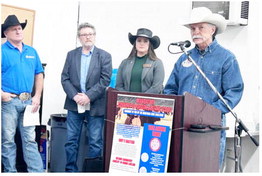
That’s why a coalition of organizations representing the state’s cattlemen and ranchers was remarkable in Billings on Tuesday, Jan. 27, as they specifically called out three-quarters of the state’s Congressional delegation for their lack of support of country-of-origin labeling for beef, something they said is costing not just cattle producers but consumers at the grocery market.
Only Rep. Ryan Zinke, Montana’s western Congressman, has announced support for mandatory country- of-origin labeling legislation for beef.
Country-of-origin labels had been used until 2015, when it was repealed due to concerns by the World Trade Organization. But, the advocates on Tuesday said world of cattle buying and selling has changed, as consolidation in the meat packing business has created an oligarchy of four large multinational producers who often don’t disclose where their beef is coming from, or instead, will label it as American because it was slaughtered and packaged domestically.
The coalition, including the U.S. Cattlemen’s Association, R-Calf, Northern Plains Resource Council, the Montana Farmers Union, the National Farmers Organization, the Montana Cattlemen’s Association, Abundant Montana and the Yellowstone Valley Food Hub, said they believe American consumers are willing to pay more for American-sourced beef, but may not have that option because of the labeling. Instead, inferior beef products from other countries may be mixed into the food chain.
Two pieces of legislation exist in Washington, D.C., that would reinstitute mandatory country-of-origin labeling, Senate Bill 421 and House Resolution 5818. Currently, any country-of-origin labeling is optional. However, beef producers on Tuesday said that consumers already know where fruits, vegetables and some other meats are sourced, and the same should be true with beef.
The coalition were also critical of Montana’s two U.S. Sens. Steve Daines and Tim Sheehy, both Republicans who have not signed onto either bill, or said they support the legislation. Rep. Troy Downing has also not announced a position on country- of-origin labeling. The Daily Montanan reached out to all three offices on Tuesday afternoon, with questions about their support or positions, but only Sheehy’s office responded by publication time.
“Sen. Sheehy believes American beef should be labeled as American beef. As a rancher, he knows firsthand the challenges we face with the over-consolidation of corporate agriculture and the introduction of foreign entities into the American food system,” a spokesperson said. “For too long, foreign-owned meat packers have controlled our food supply, and Senator Sheehy believes we must break that monopoly and offer American alternatives to increase our national food security. Bringing profitability back to agriculture is one of Sen. Sheehy’s top priorities, and he is firmly committed to ensuring that American ranchers and cattle are placed at the center of our livestock policy framework to keep American ag alive and strong.”
Bruce Shultz, a member of the National Farmers Organization, who ranches in Raynesford, said that he and many producers saw their prices plummet the year after Congress rescinded mandatory country-of-origin labeling. Shultz said he lost nearly 40 percent of the value of his market cattle the next year because large packing companies could drive down prices by buying from nearly two dozen other countries, and have a similar product on store shelves without consumers knowing the difference.
The groups also said that mandatory country-of-origin labeling must be included in the Farm Bill to make meaningful change. They said that labels should say the country of origin for the animal, and not just where it was slaughtered or packaged. Montana’s cattle industry has been hit hard in the recent decade as domestic cattle herds have reached their lowest point in 70 years, and the leaders warned that younger generations will not return to the ranch unless there is more transparency for the end customer.
Benjamin Peterson of the Montana Farmers Union from Judith Gap told the audience that since 1980, more than half the cattle ranches have been lost. And, Shultz told the group that from 2017 to 2020, in Ravalli County alone, 150 farms had closed, and more than 50,000 acres was taken out of production.
Food security
The ranchers said that the labeling practices driven by the large packing plants are also bad for consumers, who don’t know what they’re buying. He said that for the United State, cattle production is a $100 billion business, with $2 billion contributed to Montana’s state economy.
“The (current) labeling doesn’t tell the truth,” said Samantha Ferret of Toston, who ranches with her husband and serves on the U.S. Cattlemen’s Association. “Why is it not revealed where the beef comes from? This is no accident.”
The group said that if consumers could have the choice between the foreign beef and the kind raised in Montana, they’d be willing to pay a premium, which would, in turn, create more market demand, raise domestic prices and help ranchers rebuild their herds.
The organization said it’s important to label beef in several ways — where it born, raised and processed.
“There has never been a greater demand for beef directly from the producer, and that’s because they want to know what they’re buying,” said Tim Brunner, the western district director of the Montana Cattlemen’s Association from Fairfield. “Why haven’t all the elected officials put their support behind the cattle industry then?”
R-CALF, a Billings-based nation organization that supports just cattle and sheep producers, said that labeling may seem simple, but it sends a powerful message.
“Competition can only happen if the consumers have a choice, and right now the consumers can’t signal a demand for (American) beef,” said Bill Bullard, R-CALF’s chief executive. “It’s a demand signal.”
They said that it will take a coalition like the one they’ve built to demand no support of the Farm Bill without mandatory country-of-origin labeling.
“The only way to know now is if you drive it off the ranch itself,” Peterson said. “We’ve heard that politicians currently want to put America First, well mandatory country-of-origin labeling does that. They should take the easy win.”